Guide to understand what is the SQE.
Two (2) minutes to understand how to prepare for the SQE and transform your study methods
SQE - The New Way to Become a Solicitor
Have you heard of the Solicitors Qualifying Examination (SQE)? It is the fresh, all-encompassing test for aspiring solicitors, representing a major change in how people train to join the legal profession.
The Solicitors Qualifying Examination (SQE) is the new centralised assessment that aspiring solicitors in England and Wales must pass to qualify. It was introduced in September 2021 and will eventually replace the Legal Practice Course (LPC) as the main route to becoming a solicitor. To qualify as a solicitor in England and Wales through the SQE, you need to meet four requirements:
1. Degree or equivalent
You must have a degree in any subject (or equivalent qualification or work experience).
You will need to complete at least two years’ full-time (or equivalent) Qualifying Work Experience (QWE).
Learn more about QWE: SQE Qualifying Work Experience (QWE)
3. SQE assessments (SQE1 and SQE2)
You will need to pass both SQE exams - SQE1 focuses on functioning legal knowledge and SQE2 on practical legal skills and knowledge
Read the complete Syllabus up to date: SQE Syllabus
4. Character and Suitability
Your character and suitability will be considered as seriously as your knowledge and skills by the SRA before being authorised to enrol.
Can you become solicitor? Try our route finder
The SQE is a rigorous, fair and consistent assessment, ensuring all new solicitors meet the same high standards regardless of their route into the profession.
Why was the SQE introduced?
The SQE was introduced by the Solicitors Regulation Authority (SRA) to achieve four key aims:
- Greater assurance of consistent, high standards at the point of qualification
- Reflecting the modern realities of legal services
- Removing barriers and increasing access, cost-effectiveness and flexibility of qualification
- Enabling the SRA to monitor the quality of qualifying legal work experience
SQE1 Explained
SQE1 primarily tests the application of fundamental legal principles through 360 multiple choice questions, split over two exams known as FLK1 and FLK2. The assessments cover content previously taught on academic law degrees and the LPC.
FLK1 assesses candidates' functioning legal knowledge in:
- Business Law and Practice; Dispute Resolution; Contract; Tort; Legal System of England and Wales; Constitutional and Administrative Law and EU Law; and Legal Services.
FLK2 assesses functioning legal knowledge in:
- Property Practice; Wills and the Administration of Estates; Solicitors Accounts; Land Law; Trusts; Criminal Law and Practice.
Each exam lasts 5 hours 30 minutes (including breaks). In the most recent sitting (January 2026), the first-attempt pass rate was 65% for FLK1 and 61% for FLK2.
SQE2 Explained
SQE2 assesses practical legal skills through 16 exercises - four oral and 12 written - covering advocacy, client interviewing, legal research, case and matter analysis, legal writing and drafting. The skills are assessed in the context of five practice areas:
- Criminal Litigation
- Dispute Resolution
- Property Practice
- Wills and Intestacy, Probate Administration and Practice
- Business organisations, rules and procedures
SQE2 takes place over five half days. Like SQE1, it uses a pass mark rather than a graded result.
Booking and Sitting the Assessments
The SQE assessments are run by Kaplan and can only be booked via the SRA's website. SQE1 is currently available in January and July, while SQE2 is available in January, April, July and October. Bookings close around five weeks before each sitting.
SQE1 assessments take place at Pearson VUE test centres across the UK. SQE2 oral assessments take place in Cardiff, Manchester and London, while written assessments can be sat anywhere.
Candidates may attempt each assessment three times within a six year period.
SQE Costs and Funding
The total cost for the SQE assessments is £4,908 (SQE1 costs £1,934 and SQE2 costs £2,974), up around 2.5% from 2025 and rising to £5,092 from September 2026. The SRA has a list of available funding options, including scholarships, bursaries and loans.
Many law firms sponsor future trainees to take the SQE and some universities incorporate SQE preparation into their law degrees at no additional cost.
SQE Preparation Courses
While it's possible to take the SQE independently, most candidates choose to take SQE preparation courses to get exam-ready. Courses are available from many law schools and providers, either as standalone SQE1 and SQE2 programs or built into law and conversion degrees.
Key things to consider when choosing an SQE prep course:
- Curriculum - does it cover all the required content?
- Tutors - are they experienced solicitors with SQE expertise?
- Personalised support and feedback
- Volume and quality of practice questions
- Firm connections for QWE opportunities
- Price and funding options
SQE vs LPC
Unlike the LPC, the SQE doesn't involve a course but is simply a series of assessments. The content and skills assessed are similar but the SQE uses mostly multiple choice questions for legal knowledge and standardised, uniform assessments for skills.
The SQE offers more flexibility as to when and how candidates prepare compared to the highly structured LPC. It also allows qualifying work experience to be completed at up to four different organisations, rather than traditional two-year training contracts.
Read our complete SQE vs LPC guide
FAQs
Can I still qualify under the old LPC route?
Yes, provided you complete all the required elements before 31 December 2032. Transitional arrangements are in place until then for anyone who already started a law degree, conversion course or LPC before September 2021.
Do I need a law degree to take the SQE?
No, you can hold a degree or equivalent qualification in any subject. Non-law graduates will need to undertake an SQE preparation course first to gain the necessary legal knowledge.
When should I sit SQE1 and SQE2?
Most candidates sit SQE1 after completing a law degree or SQE preparation course. SQE2 is usually taken after SQE1 and the qualifying work experience, to allow practical skills to be developed first.
Can I resit the SQE assessments if I fail?
Yes, you can attempt SQE1 and SQE2 three times each. If you fail three times you cannot retake for the SQE route, unless the SRA grants permission in truly exceptional circumstances.
Useful Resources
- SQE Hub - the latest information from the SRA
- Kaplan SQE - SQE assessment logistics
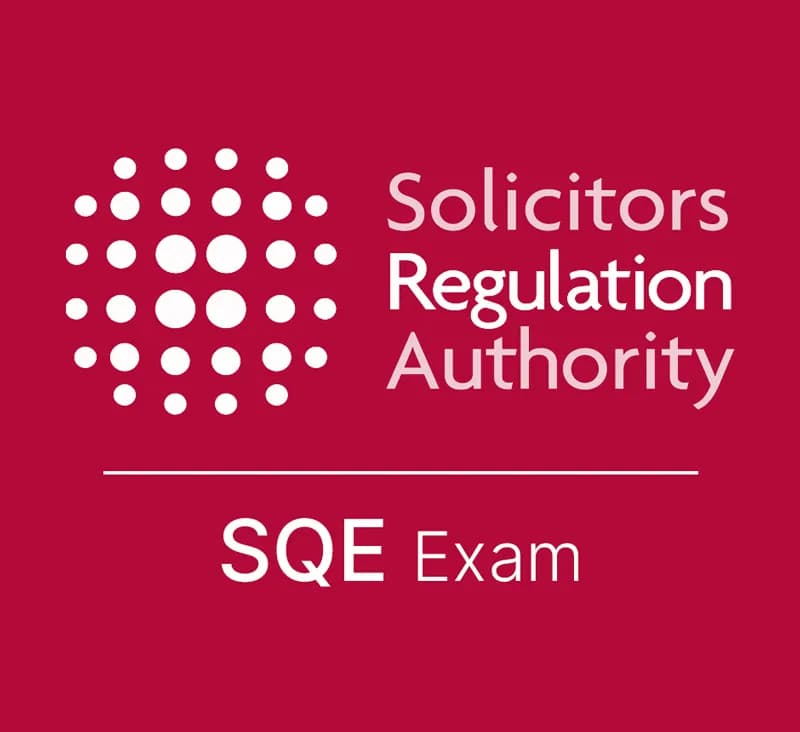
How do you qualify as a solicitor in England and Wales with SQE?
FQPS Academy aims to offer students a superior experience through exceptional guidance and excellence.

The “Day One Solicitor” Standard
The Solicitors exams are designed to test the knowledge a newly qualified solicitor would have on their first day.
What does it mean?
This means you will not be asked highly specialised or niche questions that only experienced solicitors would know. Instead, the questions are based on what is expected knowledge for a new solicitor.
However, this also means that the SQE is more challenging than the former solicitor exams, namely the LPC. The LPC assumed that candidates would become solicitors in two years, after completing their training contract. It assumed that your knowledge level was lower than that of a qualified solicitor.
In contrast, the SQE assumes you have the knowledge of a Day 1 qualified solicitor.
The Solicitors Qualifying Examination latest Pass Rates and Results (Updated 2026)
In the 2024/25 cycle, over 16,200 candidates took one or more SQE assessments — around 13,081 sat SQE1 and 5,752 sat SQE2.
In the most recent sitting (January 2026), first-attempt pass rates were 65% for FLK1 and 61% for FLK2 — 58% overall for SQE1.
For SQE2, the January 2026 first-attempt pass rate was 79%.
SQE1 and SQE2 assessments specification
This guide aims to give you a thorough understanding of both SQE1 and SQE2 exams, helping in your effective preparation for the exam day.
Assessment Day
Split into two sessions of 2 hours 33 minutes with 90 questions in each session. There will be a 60 minute break between the sessions.
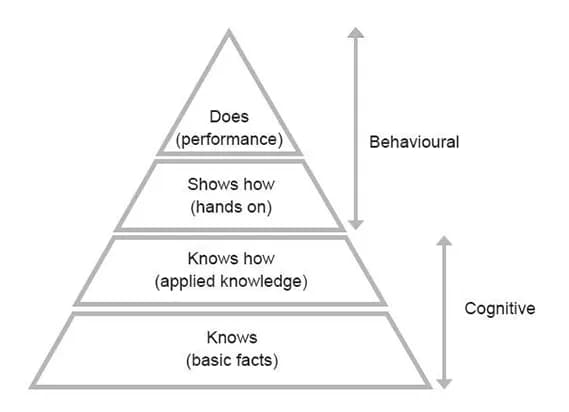
The SQE model uses Miller's pyramid* to provide a framework for the assessment of solicitor competence. Miller's pyramid is used extensively for the assessment of professional competence, including within medical and dental training.
SQE1 assesses the application of Functioning Legal Knowledge required for effective practice – the 'knows how' of Miller’s pyramid.
FLK 1
Business Law and Practice; Dispute Resolution; Contract; Tort; Legal System of England and Wales; Constitutional and Administrative Law and EU Law and Legal Services.
FLK 2
SQE2 is designed to assess your legal skills.
It includes sixteen (16) separate evaluations covering five areas of law, all interconnected with other areas. Four of these evaluations focus on your oral legal skills through Advocacy and Client interviews.
The other twelve (12) evaluations test your written legal skills, including case analysis, research, legal writing, and legal drafting.

Each Grade
Representation
In SQE2, candidates will receive grades ranging from 0 to 5, with unique assessment criteria for each station. Each assessment station will have its own evaluation grid and skills requirements.
Your performance exceeds the competency requirements of the assessment.
You clearly meet the competency requirements of the assessment.
Your performance just meets the competency requirements of the assessment, but only by a small margin.
Your performance just falls short of meeting the competency requirements of the assessment; only by a small margin.
Your performance clearly does not meet the competency requirements of the assessment.
Your performance is well below the competency requirements of the assessment.
SQE1 and SQE2: Understand the D-Day Organisation
Understanding the organisation of SQE1 and SQE2 exam days will help you be better prepared.
On average, you will have 1.7 minutes per question.
1st Session: 90 Questions - 2 hours 33 minutes
Break: 60 minutes
2nd Session: 90 Questions - 2 hours 33 minutes
1st Session: 90 Questions - 2 hours 33 minutes
Break: 60 minutes
2nd Session: 90 Questions - 2 hours 33 minutes
Dispute Resolution - Property Practice
Criminal Litigation - Wills and Probate
Criminal Litigation - Dispute Resolution
Property Practice - Wills and Probate
Business Law
People also ask
Find your answers here. If you don’t find it here, please contact us